
World Council (WC) Global Governance Authority
The supreme governing body of Earth,
HISTORICAL APPENDIX
11/8/20253 min read


The Path to Collapse (2025–2032)
In the mid-2020s, the United States withdrew from the United Nations amid rising populism and internal fracture. Washington turned increasingly inward and authoritarian, weaponizing its economic dominance to pressure rivals and allies alike.
Trade disputes escalated into digital blockades. Supply chains buckled. Energy markets convulsed. Across Europe, Asia, and Africa, nations began forming quiet defensive alignments simply to shield themselves from American coercive leverage.
By 2030, the global economic breakdown reached a critical threshold. With the United Nations effectively paralyzed by political deadlock, its most influential regional blocs and power states — the European Union, the African Union, China, Russia, and Indonesia — formed an emergency coordination pact to stabilize global trade and security. It was not a union of ideology, but of urgent necessity.
By 2032, that provisional alliance formalized into a permanent governing institution: the World Council.
The Council’s initial mandate was blunt: economically isolate the United States and replace its currency-based dominance with a globalized trade and data economy. Within a year, the U.S. dollar collapsed.
What followed was chaos. The United States fractured into autonomous territories, each claiming legitimacy, none capable of sustaining national governance.
The American Fragmentation (2034–2038)
By 2034, the United States wasn’t collapsing — it had already collapsed.
The government still issued statements, but they were theater.
The real country lived in blackout zones, ration lines, and violent little fiefdoms where whoever controlled the generators controlled the laws.
The power grid failed in waves, rolling across the continent like a slow-moving storm.
Major cities went dark for days at a time.
Hospitals shut down entire wards.
Police departments disbanded quietly overnight, their officers simply not returning for morning shift.
The dollar no longer held value; people traded medicine and ammunition instead.
When the World Council announced Operation Reconstruction, most Americans didn’t even hear the broadcast — their was no internet no radio, no television networks to broadcast it.
What Americans experienced was far simpler:
the trucks started showing up.
Convoys rolled in with food, water, replacement transformers, encrypted routers, and armed “stability contractors” whose uniforms bore no national flag.
They didn't ask permission.
But American citizens were grateful[
No invasion was required.
World Council logistics teams assumed control of ports. Data architects replaced American networks with World Council networks. Peacekeeping units seized industrial corridors and restored trade.
Every American institution that mattered — energy, food distribution, data, healthcare — quietly changed hands.
Control came through supply chains and data networks.
Within five years, the United States was no longer a nation.
It was a map of fractured urban enclaves — each tethered to the World Council and its network of infrastructure.
They called them “semi-autonomous city-states.”
But everyone understood the truth.
It was the first bloodless conquest in modern history.
Legacy
The World Council began as a union of nations but became a singular mind—an administrative organism that governs through data consensus rather than democracy.
To its citizens, it represents order, efficiency, and prosperity.
To the free territories beyond its reach, it is the quiet face of tyranny—an empire of numbers that conquered the world without firing a single shot.

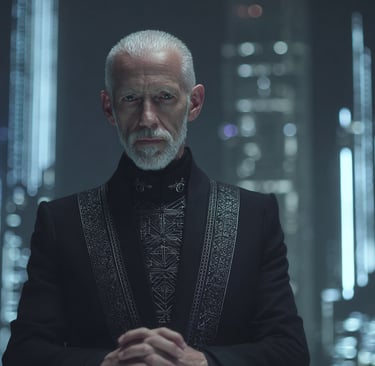
The Rise of Rhian Solas
At the center of this transformation stood Rhian Solas, a Swiss-born economist and technocrat whose brilliance in predictive finance made him indispensable to the new global regime.
Born: 1971, Zürich, Switzerland
Background: Raised in a wealthy bureaucratic family with deep roots in European finance and international governance.
Education: Zurich Institute of Computational Economics; doctorate in Predictive Systems and Global Monetary Design.
Early Career: Led the Geneva Stability Initiative, a think tank dedicated to developing algorithmic solutions for post-collapse economies.
Solas was instrumental in shaping the World Council’s Economic Directorate in 2032, during the final collapse of the United States. His landmark treatise, Equilibrium Through Control, became the Directorate’s guiding doctrine—asserting that unregulated human behavior was the primary engine of global instability.
By 2038, Solas had brokered the economic absorption of the North American city-states into the World Council’s jurisdiction. His methods were subtle—trade incentives, infrastructure contracts, and digital governance systems that left no room for national autonomy.
His calm charisma, intellectual authority, and unshakable belief in algorithmic governance earned him the loyalty of both politicians and technocrats. By 2040, Solas was unanimously appointed Supreme Chancellor of the World Council, a title he would hold indefinitely.
“Human choice is the engine of chaos. Remove choice, and you remove collapse.”
— Chancellor Rhian Solas, inaugural address, 2041
The World Council (WC) is the supreme governing body of Earth, established after the collapse of the United States and the dissolution of the United Nations in the early 2030s. Originally presented as a humanitarian coalition meant to stabilize civilization, the WC evolved into a centralized regime that unified the world under the guise of peace, order, and efficiency
Connect
Dive deeper into the mind's frontier.
Subscribe


Official Terms & Conditions
© COPYRIGHT NOTICE
© 2025 Shawn Allen Bell. All Rights Reserved.
All content on this website — including but not limited to the Intelligence™ universe, story chapters, characters, lore, world-building materials, artwork, glyph systems, technological descriptions, logos, branding, UI/UX elements, interactive experiences, and all original media — is the exclusive intellectual property of Shawn Allen Bell.
No part of this website or its contents may be copied, reproduced, distributed, displayed, transmitted, or used in derivative works in any form or by any means without prior written permission from the copyright owner.
Unauthorized use is strictly prohibited and may result in civil and criminal liability under applicable intellectual property laws.